Bramberwick Common
You can cross Bramberwick Common in a few minutes, provided nobody stops you for a conversation.
The Common is a shared green space where the town’s everyday routines meet. Its paths carry people between errands, its benches offer somewhere to pause, and its open ground makes room for gatherings that occasionally require weeks of preparation.
Some residents come here with a purpose. Others come because it is a pleasant place to have none.
The town between appointments
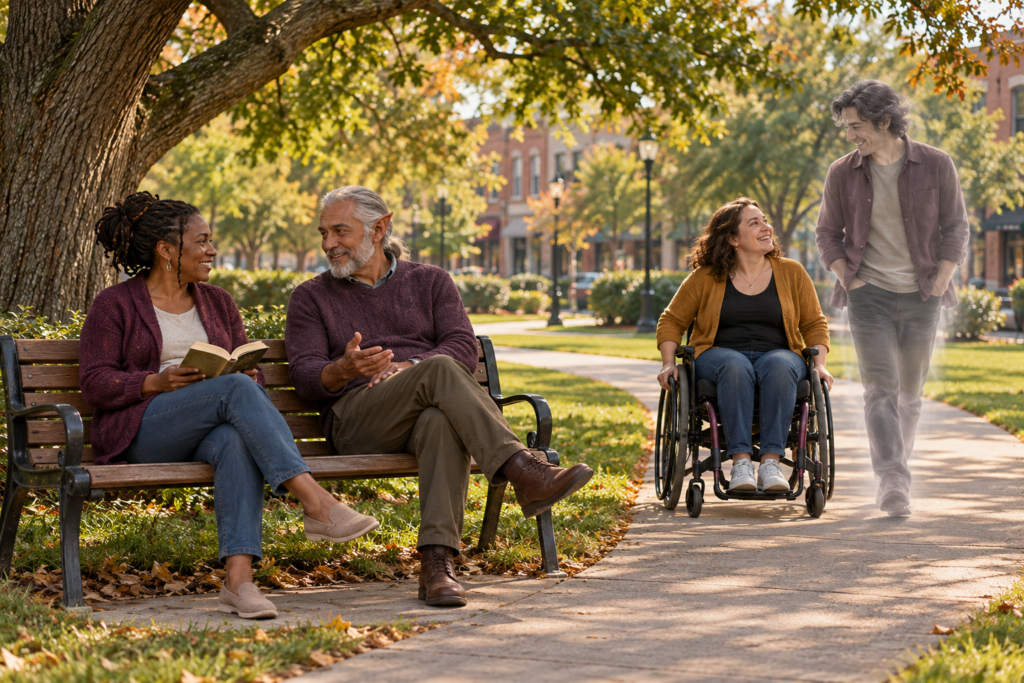
On an ordinary day, the Common belongs to walkers, readers, families, and people taking their lunch outside.
Neighbors exchange news beside the paths. Children negotiate the rules of games with a seriousness that would be useful at certain public meetings. Someone settles onto a bench with a book and discovers, an hour later, that they have read very little of it.
There is room for company and room to be left alone. Bramberwick does not always judge correctly which one a person wants, but asking usually helps.
You are welcome to sit without making yourself useful.
When the Common fills
For festivals and larger gatherings, the familiar green becomes a working space.
Stall positions are marked out. Supplies arrive. Signs go up, are reconsidered, and sometimes go up somewhere else. Clear routes must be kept between activities, and the people carrying equipment appreciate being noticed before a conversation blocks their way.
The Harvest Revel brings one of the Common’s busiest periods, with preparations beginning well before the public celebrations.
Much of the work is done by residents who will return afterward to take everything down. The festival may finish late; the borrowed tables still need to go home.
Sharing the space
A public place has to accommodate people who use it differently.
Some need a clear path or a place to rest. Others need distance from noise, strong scents, or an activity whose effects extend farther than its organizer expected.
Please keep belongings and equipment out of the walkways. Ask before including someone in a performance, demonstration, photograph, or enchantment. Being nearby does not necessarily make them a participant.
Children and companions should be supervised according to their needs. An assurance that something “usually comes back” is not a substitute for keeping track of it.
A Common through the seasons
The Common changes with the year.
Spring brings new growth and more reasons to linger outdoors. Summer draws people toward the shade. Autumn fills the paths with leaves and the calendar with preparations. Winter makes a sunny bench particularly valuable and a short conversation rather more likely to remain short.
Weather affects gatherings, maintenance, and the condition of the ground. Organizers may move activities, change arrangements, or ask visitors to leave a recovering patch of grass alone.
A place used by so many people needs time and care between occasions.
Everyone has an opinion
The Common is part of everyday life, which makes decisions about it surprisingly personal.
A proposed gathering, a moved bench, or a change to a familiar route can produce strong views from people who had not previously considered themselves interested in the matter.
Residents disagree about what the space needs and which uses should take priority. Those discussions belong to the life of the town, too.
Caring about a shared place includes considering what makes it usable for somebody else.
What's happening on the Common
The Chronicle covers gatherings, preparations, and community decisions involving the Common. The town calendar lists scheduled public activities, while individual notices explain arrangements for particular events.
There is also plenty to enjoy between entries on the calendar.