The parcel was waiting inside the museum when Miriam Vale unlocked the building on Monday morning.
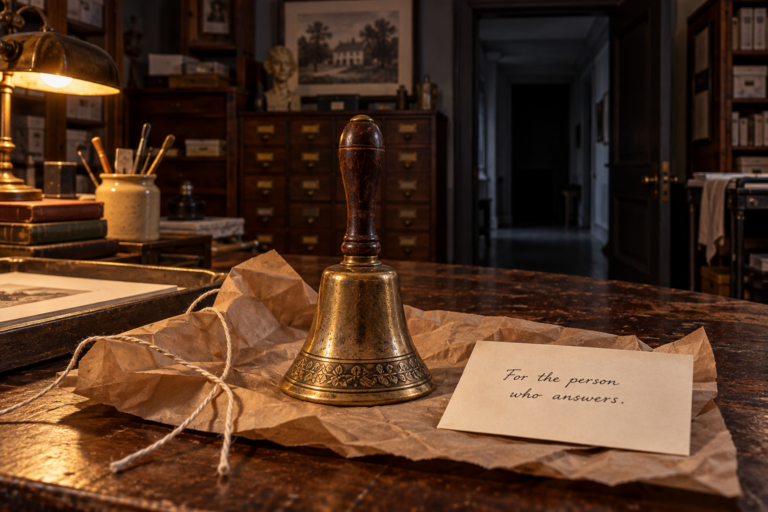
It sat squarely in the middle of the reception desk, wrapped in brown paper and tied with cotton string. There was no delivery label, no accompanying letter, and no indication of who had brought it.
The desk had been clear when the museum closed.
Miss Vale checked the doors and accessible windows before opening the parcel. She found no damage. No member of staff has acknowledged leaving it, and the museum’s delivery records offer no explanation.
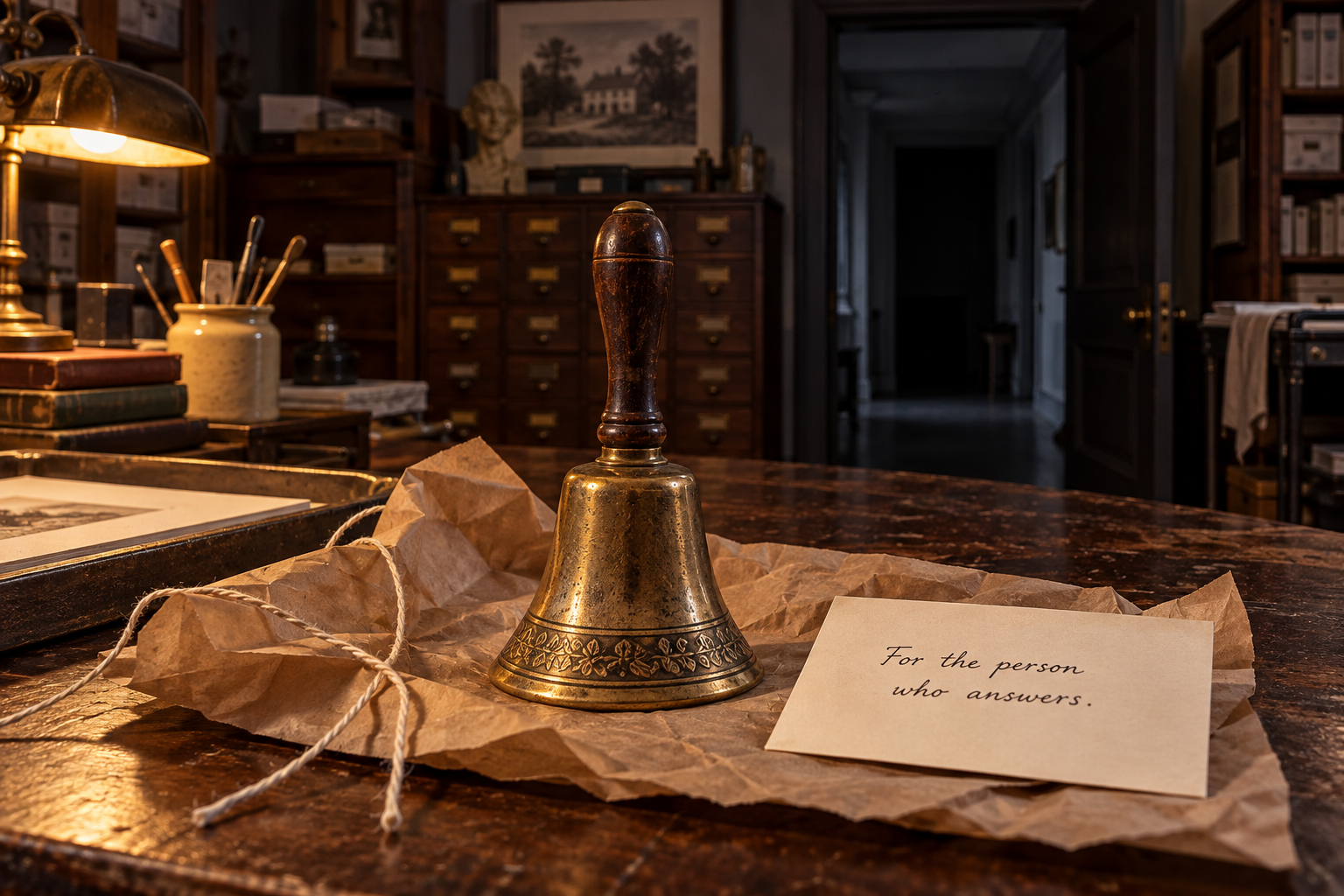
Inside was a small brass handbell.
A bell without a clapper
The bell stands a little over four inches high, with a dark wooden handle worn smooth by use. A narrow band of engraved leaves runs around its rim. There is no maker’s mark.
There is also no clapper.
That absence might have made the object unremarkable: a damaged household bell, perhaps, or something removed from service and kept for sentimental reasons. Miss Vale examined the interior and found no obvious sign that a clapper had recently broken away.
The wrapping contained one other item.
A small cream card had been tucked beneath the string. On it, in careful handwriting, were the words:
For the person who answers.
No name followed.
“It is not a donation form,” Miss Vale observed.
She placed the bell in the museum’s workroom while she began checking the collection records.
The first sound
At approximately eleven that morning, Miss Vale heard a bell ring from the workroom.
She was in the adjoining archive. No one else was working in that part of the building.
The sound was brief: one clear note, followed by silence.
When she entered the room, the bell remained where she had left it. The cream card lay beside it. Neither appeared to have moved.
Miss Vale checked for another possible source, including objects in nearby cabinets and sounds from the street. She found nothing that accounted for what she had heard.
The bell rang again shortly after closing.
On that occasion, she was present.
“It did not move,” she said. “I was watching it.”
Asked whether she had answered, she paused before replying.
“No.”
An incomplete resemblance
The museum holds several bells, including examples associated with shops, households, and public buildings. None matches the new arrival closely enough to establish its origin.
One photograph has attracted Miss Vale’s attention.
It shows an unidentified woman standing beside a doorway, holding what may be a similar bell. The image is faded, and the lower portion of the object is obscured by her hand. Its wooden handle appears to be the same shape.
The photograph’s reverse bears an old catalog number but no name, address, or date. The corresponding entry describes it only as woman at door.
Miss Vale has not accepted this as a match.
“A resemblance is a reason to keep looking,” she said. “It is not a provenance.”
The photograph and the bell are now being examined separately. The museum would welcome information from anyone who recognizes the description, particularly residents familiar with older household collections or the contents of buildings cleared in recent years.
Anyone claiming ownership will be asked to provide more than an interest in taking it home.
What happened on Wednesday
By Wednesday afternoon, the bell had been moved into a secured cabinet in the workroom.
During a conversation there, I asked Miss Vale whether the wording on the card suggested that the object had been intended for someone specific.
She said that it might.
The bell rang.
We both heard it.
A moment later, three knocks came from the workroom door.
Miss Vale raised one hand before I could speak. She crossed the room and opened the door herself.
The corridor was empty.
I had entered through that corridor several minutes earlier. There is no nearby turn behind which someone could have disappeared quickly, although I cannot account for every movement elsewhere in the building.
We inspected the adjoining rooms. No visitor was found.
On returning to the workroom, Miss Vale checked the card against the photograph she had taken of it on Monday.
The wording was unchanged.
She then closed the cabinet.
For now, a restricted acquisition
The bell will not be placed on public display while its origin and behavior remain uncertain.
Museum staff have been instructed to record any further sounds, including their times and any activity immediately preceding them. They have also been asked not to ring the bell deliberately, speak in response to it, or treat knocking in that part of the building as sufficient evidence of a visitor.
These precautions may eventually prove unnecessary. At present, there is too little information to dismiss them.
Miss Vale declined to speculate about what might happened if someone answered.
“I should prefer,” she said, “to learn that from a record.”
The parcel’s sender, if they are reading, is invited to contact the museum with an explanation. A name would be a useful beginning.