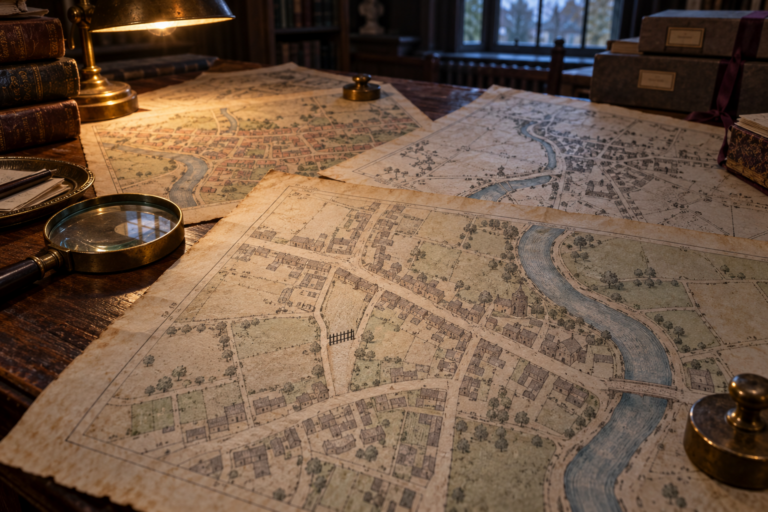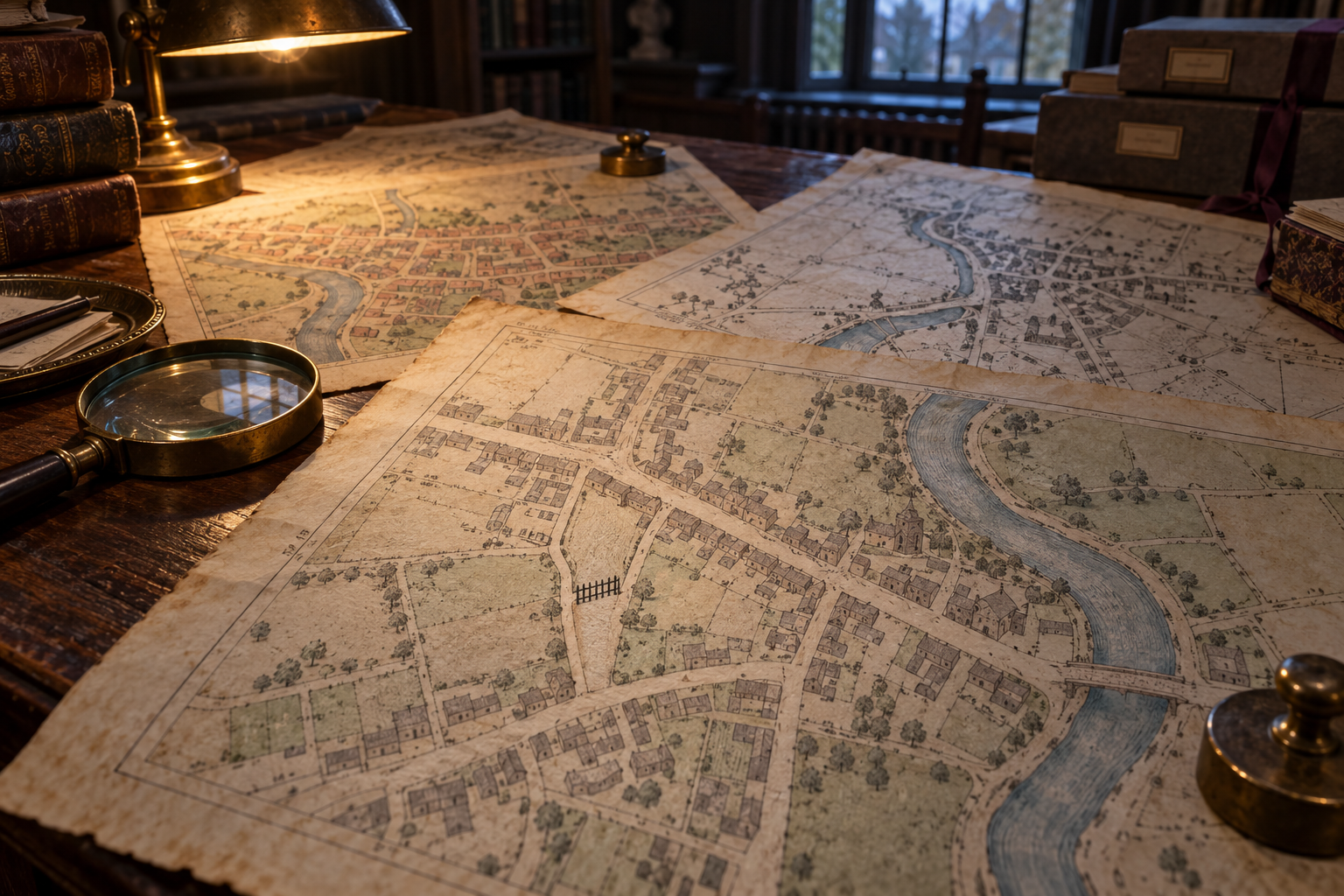
On the oldest of the maps currently laid out in the museum’s reading room, Rook Lane turns away from the Common beside a building that no longer stands.
On another, it begins near the river.
A later edition places it between two properties whose owners would have considerable difficulty accommodating a road.
The lane is short in every version. It has no marked destination, no numbered buildings, and no obvious purpose beyond reaching the edge of the paper’s certainty.
Across its entrance, someone has drawn a gate.
A persistent feature
Archivist Miriam Vale began comparing the maps after a visitor asked how to reach Rook Lane.
The question was ordinary enough. Visitors frequently arrive with old directions, family recollections, or a firm conviction that a building must still be there because someone photographed it in 1934.
The visitor had no map. She said the name had been given to her.
She left before staff thought to ask by whom.
The museum’s first search found the lane on a town plan. Checking its position against a second edition produced a discrepancy. A third made it clear that comparing only two would not be sufficient.
So far, Rook Lane appears on every complete town map examined for the inquiry.
It does not remain in the same place.
What the maps agree on
Changes between maps are not unusual in Bramberwick.
Buildings are altered, paths move, and a survey may record a perfectly accurate arrangement that has become inconveniently historical by the time the copies are distributed.
Rook Lane presents a different problem.
Its position changes relative to landmarks that otherwise agree. On one sheet, it occupies ground shown as a garden on another. On a third, the same stretch of ground contains no opening at all, while the lane has appeared elsewhere.
There is no indication that the mapmakers intend to record a relocation.
Each gives it the same name.
Each depicts a narrow entrance and a short length of road.
And each has acquired the little gate.
An addition by hand
The gates were not printed with the maps.
Under magnification, their lines can be distinguished from the surrounding work. Some were added in pencil, others in ink. One is drawn so lightly that staff initially mistook it for a crease.
They are not identical. Some have five bars, some fewer. One consists of two posts and a line that appears to have been sufficient for whoever drew it.
The marks appear to be the work of different hands.
That observation has attracted more attention than Miriam considers helpful.
“Different people adding the same feature may indicate a shared instruction,” she said. “We have not yet found the instruction.”
Asked whether the gates represented something physically present, she replied that this was among the questions being investigated.
She declined to choose a map on which someone might go and look.
No address to match
The museum has not yet found a corresponding entry in the address records so far.
There are no identified households to place along the lane and no clear account of what stood at its end. References to similarly named places outside Bramberwick have not resolved the matter.
Residents asked about Rook Lane have generally said they do not know it.
Several have suggested other lanes. One was certain the name belonged to a shop, although he could not say what it sold.
The museum would welcome documentary evidence: an addressed envelope, a dated photograph, written directions, or a family paper that mentions the name in context.
A recollection may also be useful. Staff ask that residents distinguish between remembering the place and remembering someone talking about it.
Both belong in the record. They are different kinds of information.
Keeping the originals
For now, the maps remain under examination.
Visitors wishing to consult them should ask at the museum desk. Staff will make suitable copies available while the original annotations are recorded.
Please do not add a gate to a map that appears to lack one.
The museum needs to establish which marks were already present when the material entered its care. A well-intended correction would make that considerably harder.
Nor should the absence of a gate be taken as an invitation to supply an opening.
That last point was Miriam’s addition to the handling instructions.
When asked whether it referred to the drawing or the road, she said she would prefer it to cover both.