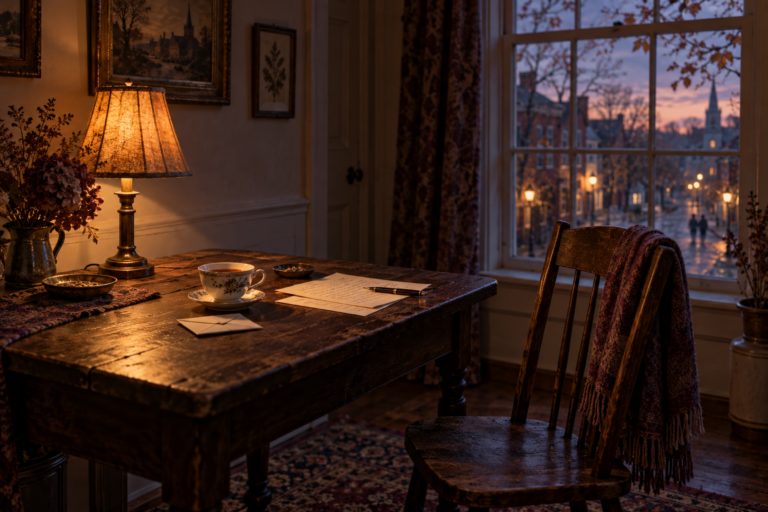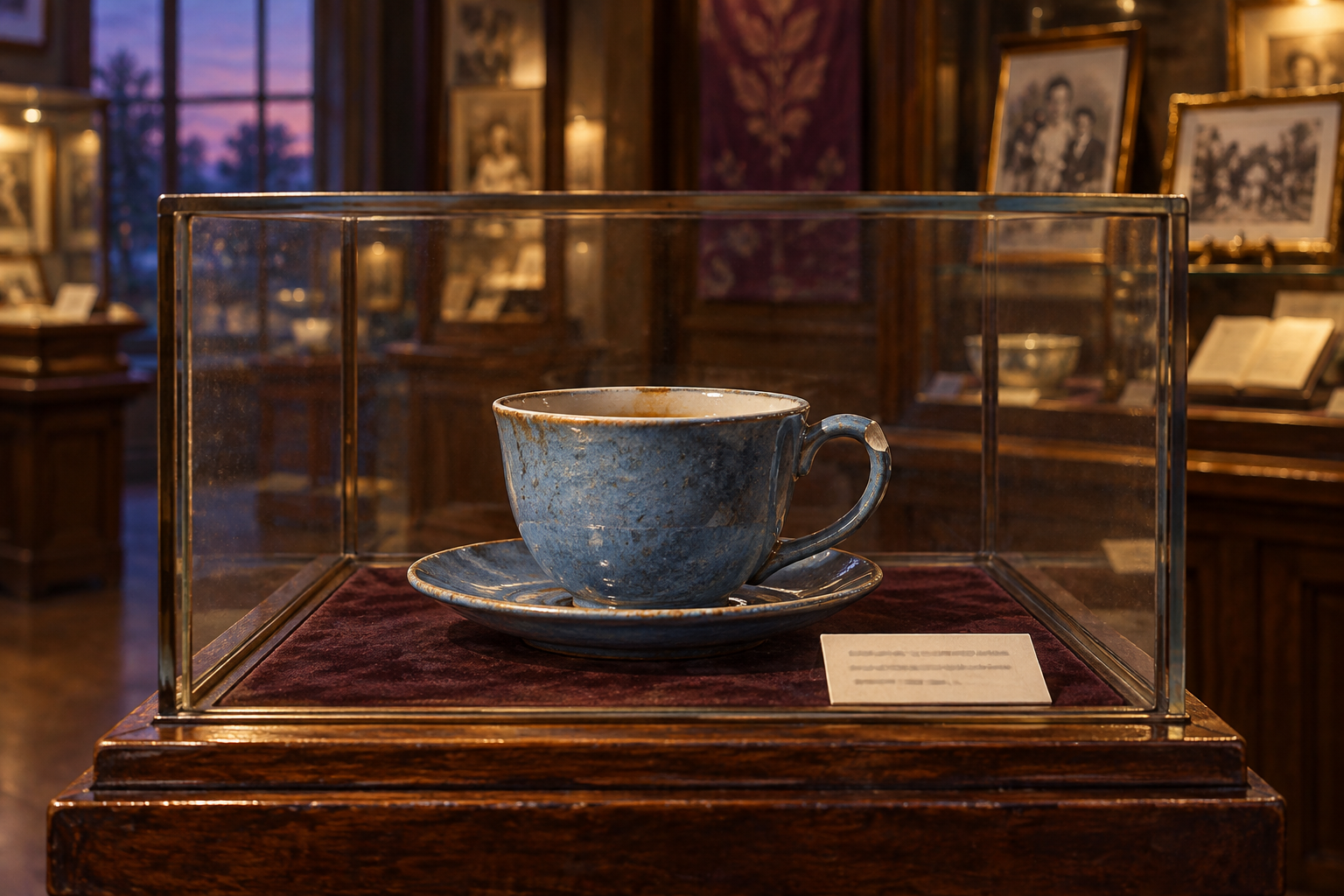
The blue cup has a chipped handle and a faint brown line inside its rim.
It belonged to a woman who used it every morning for thirty-two years. After her death, her husband continued setting it beside his own.
The museum’s record includes the cup’s approximate age, its maker, and the date it entered the collection. A separate note records something its donor considered more important.
She had disliked every replacement anyone had bought her.
As Bramberwick prepares for the Harvest Revel and the observances surrounding Samhain, the museum is selecting objects associated with the remembrance. Some were made for that purpose. Others became important through use, affection, or the simple fact that they were left behind.
The blue cup belongs to the latter group.
Objects with someone attached
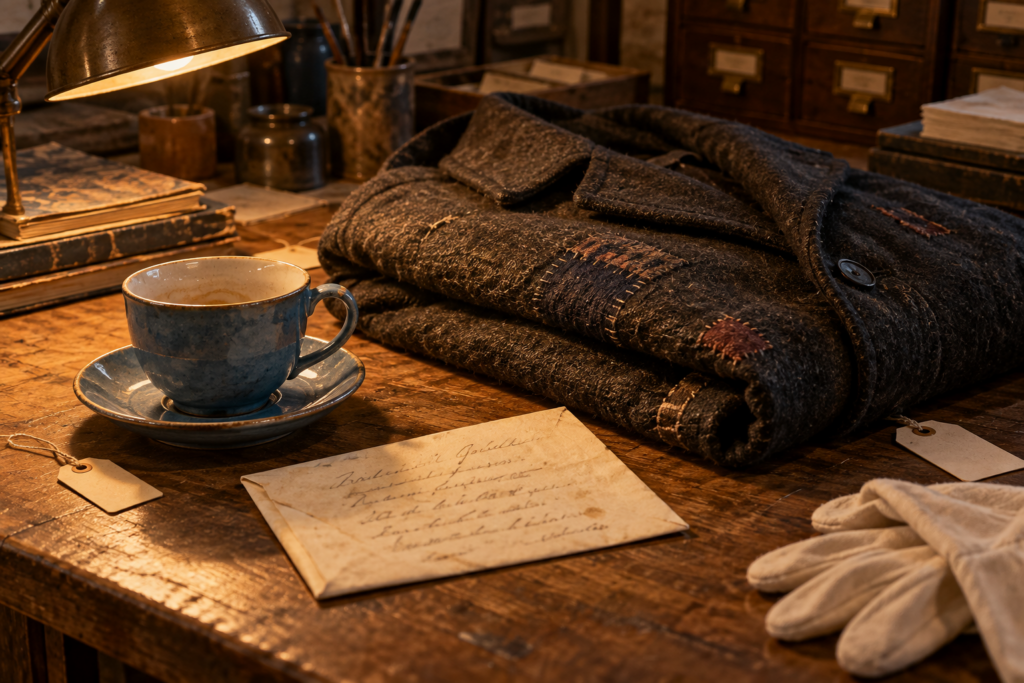
A mended coat, a recipe written on the back of an envelope, a pair of spectacles kept in their case: these are not remarkable objects until somebody explains them.
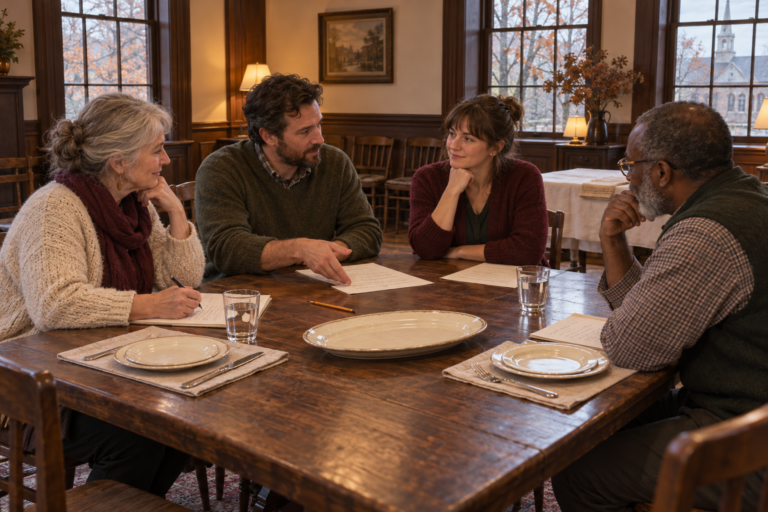
Museum archivist Miriam Vale has been reviewing those explanations alongside the objects themselves.
“The record often begins with a name and a date,” she said. “The useful part may be further down.”
One recipe in the collection includes an instruction to use a particular pan. The donor’s account explains that its author used whichever pan was clean and blamed disappointing results on everyone else’s choice.
A coat has been repaired with several different colors of thread. Its owner taught successive children and grandchildren to mend by allowing them to practice on it.
A wooden game piece has almost no distinguishing features. The accompanying letter describes a player who carried it in his pocket because he suspected his family of replacing it when he was losing.
These details preserve something beyond ownership. They allow a person to remain particular.
A place at the table
Among Bramberwick’s households, setting aside a place for someone who has died is one familiar way of remembering. The form varies.
Some families lay a complete setting. Others put out a cup, a photograph, or a dish the person enjoyed. Some speak names aloud. Some tell stories over supper, including stories the departed would have preferred everyone to forget.
Samhain observances form an important part of the Revel for some people. Other residents approach remembrance through different traditions, or through no religious practice at all.
The museum is recording who contributed each account and how they described its meaning.
“A similarity between two objects does not tell us that their owners understood them in the same way,” Miss Vale said.
For visitors, the simplest courtesy is to ask before participating – and to accept that some gatherings remain private.
When the person is still here
Remembrance becomes complicated in a town where death does not always end a person’s presence.
Some departed residents remain able to speak, visit, or complain about the alterations made to a familiar building. Others appear only occasionally. Still others are beyond any contact the people who loved them can establish.
A place setting can mean something different in each household.
One account in the collection describes a family who continued holding an annual supper for a relative who remained present as a ghost. Eventually, she asked them to stop discussing her exclusively in the past tense.
They moved the supper to her birthday.
The museum also holds a letter from someone who had spent years preparing for a return that never came. They donated the objects associated with that vigil after deciding to remember the person in another way.
Neither account establishes what anyone else should do.
It is possible to miss someone who still visits. It is possible to love someone without leaving a chair empty forever.
Keeping the difficult things
Affectionate stories are easier to share than complicated ones.
Miss Vale has asked contributors not to remove every disagreement from their accounts. A person remembered for only kindness may become difficult for their own family to recognize.
That does not mean private pain must be placed in a display case.
Some material remains restricted at a donor’s request. Some has been declined because the person offering it could not establish a right to share it. The museum’s interest in an object does not settle those questions.
The work requires judgment: what to preserve, what to exhibit, and what to leave in the care of the people concerned.
A name on a label cannot answer all of them.
Before the Revel
The museum plans to display a selection of remembrance objects during the festival, with accounts provided by their donors. Final arrangements are still being checked.
The blue cup is among the proposed exhibits.
The unexplained bell reported earlier this month is not. It remains in the secured workroom cabinet while inquiries continue. Miss Vale was clear that proximity to a remembrance exhibition would provide no evidence of its purpose.
Residents wishing to offer objects or written recollections should speak to the museum before bringing them in. Staff will discuss provenance, permission, and whether an item is suitable for the collection.
For those keeping their own observances, there is no obligation to donate anything.
A familiar object may be most useful where it has always been: on a shelf, in a pocket, or beside another cup at breakfast.